
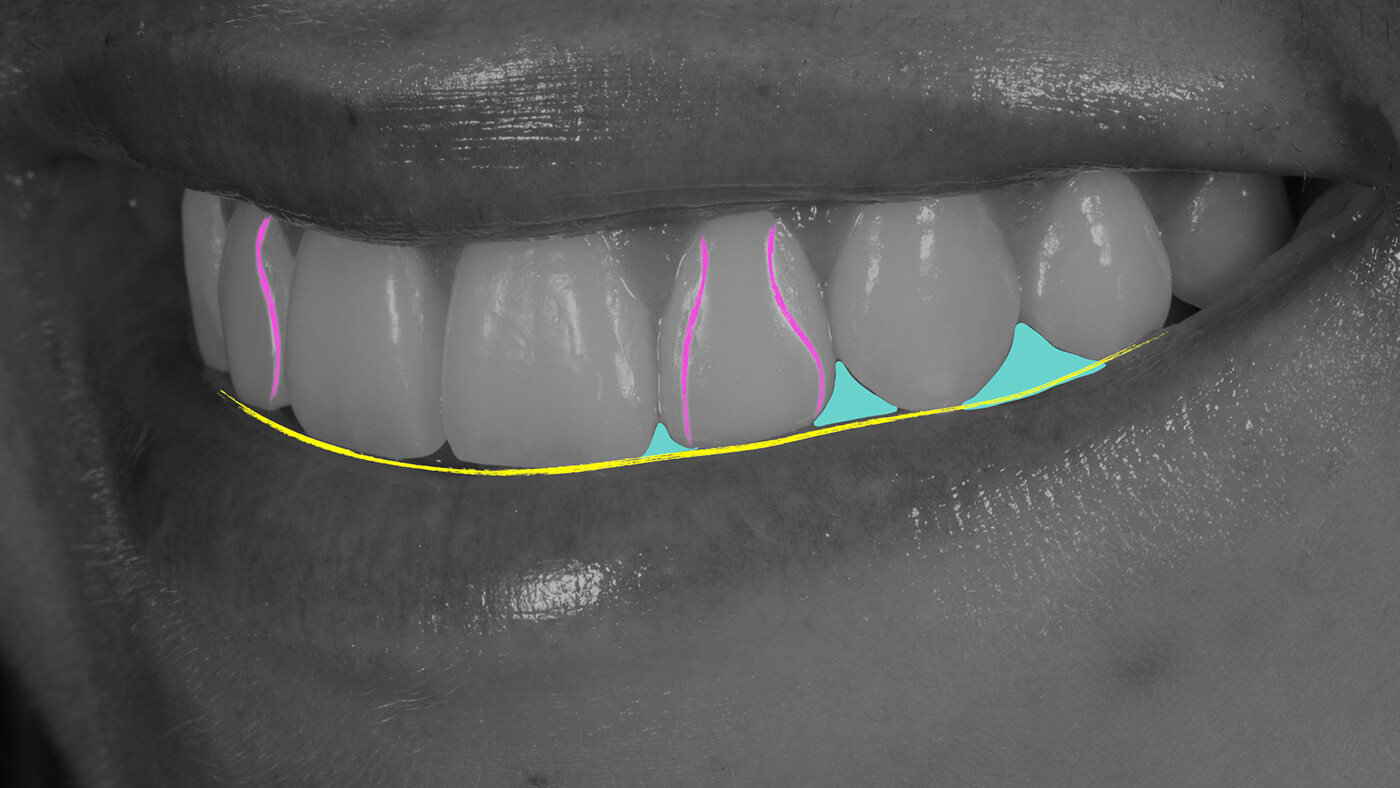
When a patient tells you she needs braces, look at the shape of the teeth before you look at their position.
This patient had worn braces when she was younger, and her teeth no longer looked the way they used to. She assumed she needed orthodontics again. This is very common. Patients think this tooth is short or that one sticks out, so they must need everything lined up. They don’t know that the problem may be morphology.
Diagnosis: Undersized Laterals
I took photos from all different angles. Looking laterally, from left to right, there was a break in the smile curvature, and the right side was a little worse than the left. The retracted views confirmed it: the laterals were undersized, and they were short at both ends. They needed length incisally and cervically.
So, the treatment plan was crown lengthening on #7 and #10 and composite veneers on #7 and #10. She did not need ortho.
Add Length in Two Directions
Composite adds the incisal length. Crown lengthening adds the cervical length. If you only add incisally, you’re solving half of the problem.
Let the Mock-Up Make the Case
Before committing to anything, I did a mock-up. It took 20 seconds: rough composite on #7 and #10, no polishing, one quick photo. She didn’t get numbed up, and I did no real work on her teeth. It’s like trying on a wig, right? The patient sees whether it’s what she wants before you commit to anything.
She looked at the photo and said that was what she wanted. Then I popped it off and showed her why orthodontics was not going to make her happy with her smile: the issue was the shape of those teeth. I didn’t have to argue the diagnosis. She could see it for herself.
Here’s the pearl: you can do this tomorrow, with the composite you already have.
Treatment With One Body Shade
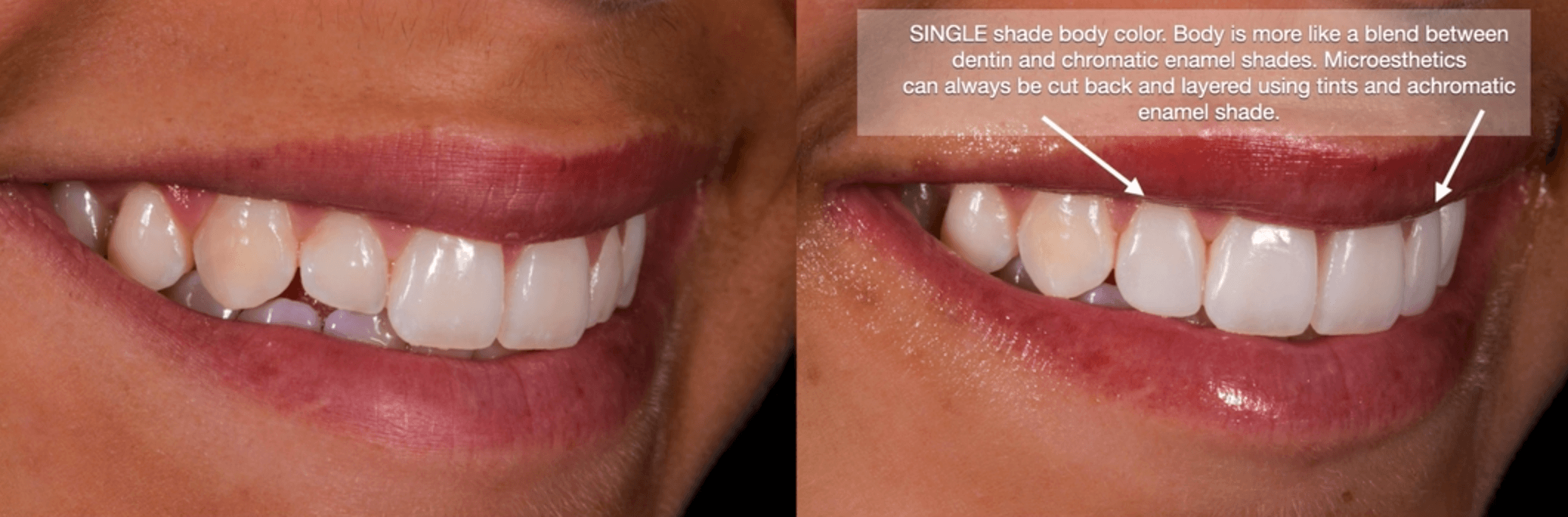
She whitened first. Then, on the same day, we did the gum lift and the composites, with the bone at the very end. A patient who expected orthodontics got crown lengthening and composite veneers on two teeth instead.
I restored both laterals with one single shade, a body shade. A body shade is really a blend between a chromatic enamel and a dentin shade, sort of like your universal shade. I was tempted to cut a window and add more micro-esthetics and translucency, but the result didn’t need it. The shape did the work. That’s a dramatic before and after with just two teeth and one shade.
Evaluate Morphology in One Color
Here’s the thing: shape is easier to evaluate when you take color away. That’s why I tell you that if you want to practice anatomy, pour up stone models or print digital models. They’re monochromatic, so you can really evaluate the anatomy. Black-and-white photos work the same way. When I evaluate a case like this, I go through four things:
S curve. What is the shape of the lateral? This patient had a built-in S curve, so I followed that natural outline and extended it.
Transitional line angles. Are they triangular, or do they dip in? The restoration should follow what’s already there.
Smile curve. Connect the incisal edges of the teeth. Before treatment, the line was disrupted, kind of a seagull wing. After I extended the laterals, it followed her lower lip. Then look at the curve of the gingival architecture. Crown lengthening let me round it out to mimic the smile.
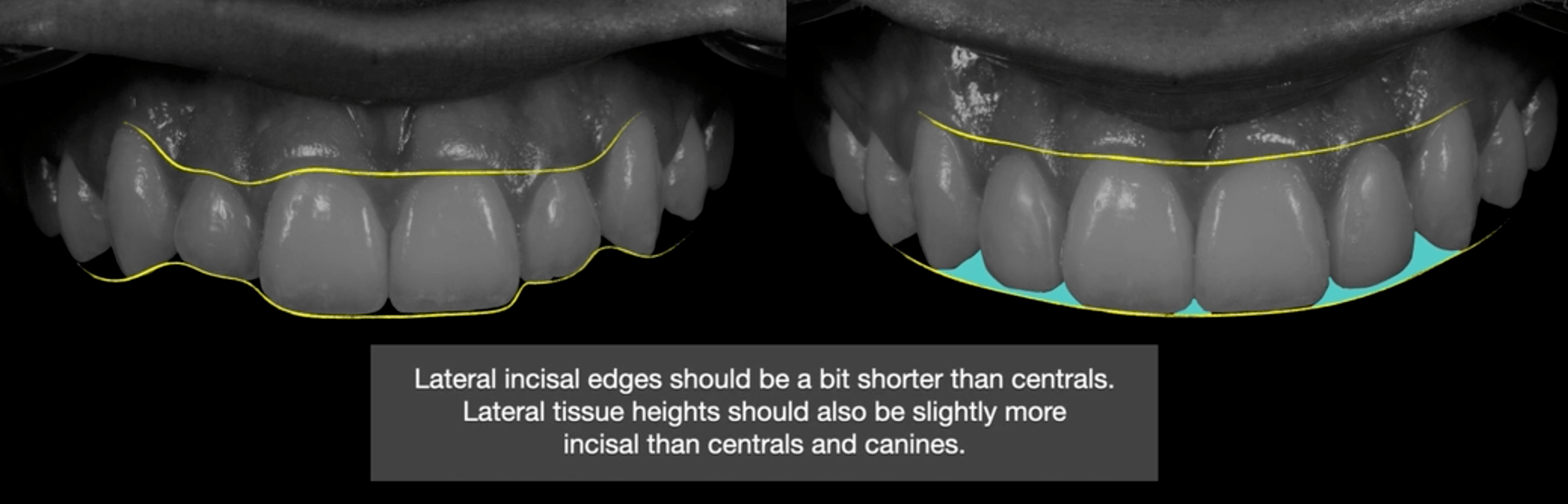
Negative space. This is what I call the cervical and incisal embrasure spaces. They’re usually smallest between #8 and #9. As you move from anterior to posterior, they get bigger and a little more scalloped, kind of like a curtain. After I corrected the lateral, the embrasures were more symmetrical and opened up slowly from front to back.
The key to this case was following the anatomy already present in the lateral and extending its length. In the full tip, I walk through the before and after from every view, in color and in black and white. Watch it for free.
Three Key Takeaways from This Case
-
Diagnose shape before position: Undersized laterals can read to a patient as an orthodontic problem when the issue is tooth morphology.
-
Mock it up first: A 20-second composite mock-up lets the patient see that the answer is shape, not orthodontics.
-
Evaluate in monochrome: Removing color makes the S curve, line angles, smile curve, and embrasure spaces easier to assess.